


Every Custom Printed Pouches (CPP) pouch is made from one of six three-layer films: a white, clear or metallic base with a matte BOPP or gloss PET exterior. Choose the base for opacity, product visibility and the listed barrier specifications; choose matte or gloss for the surface appearance. Compare the complete films below, then download the specs for your shortlist.
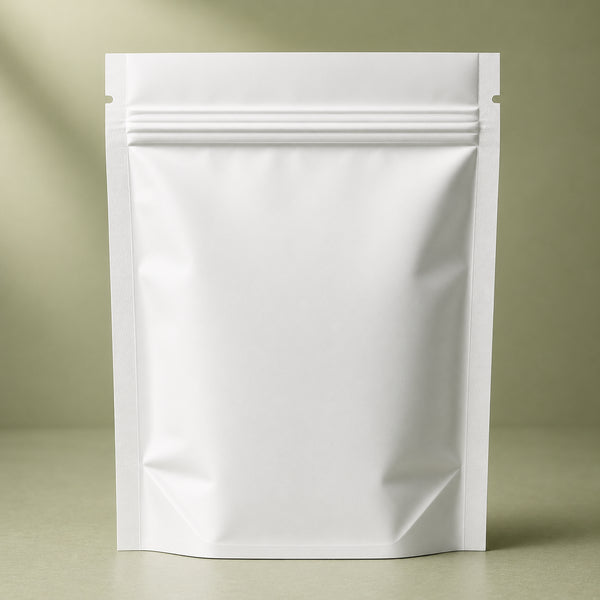 White Matte BOPPOpaque white base, smooth low-sheen finish.
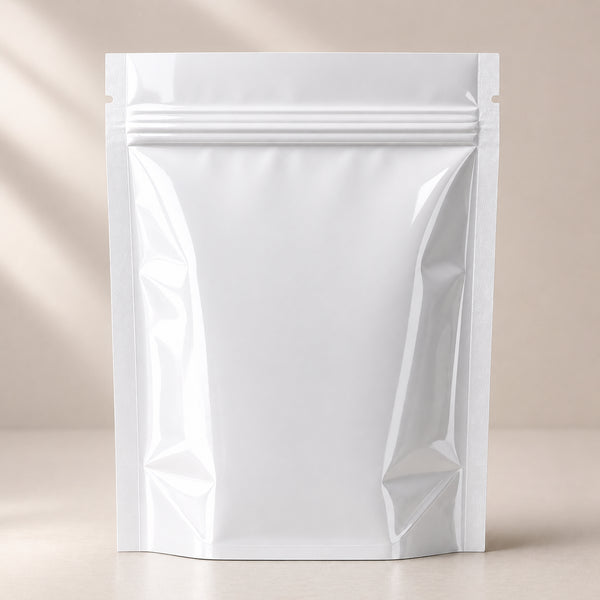 White Gloss PETOpaque white base, bright reflective finish.
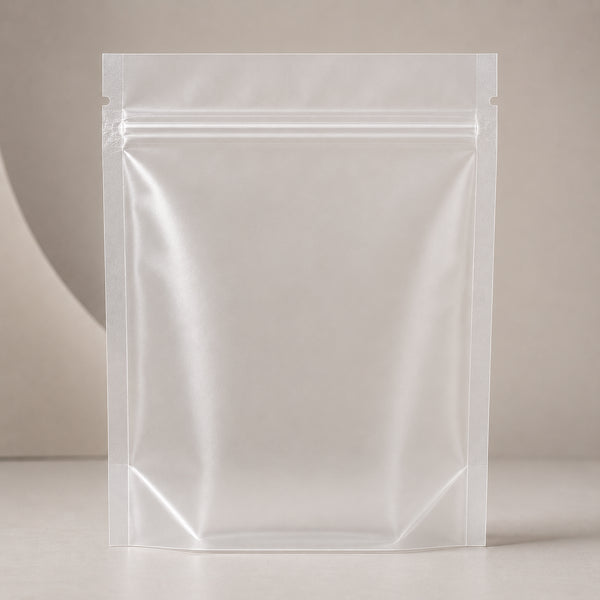 Clear Matte BOPPSoft, frosted view of the product.
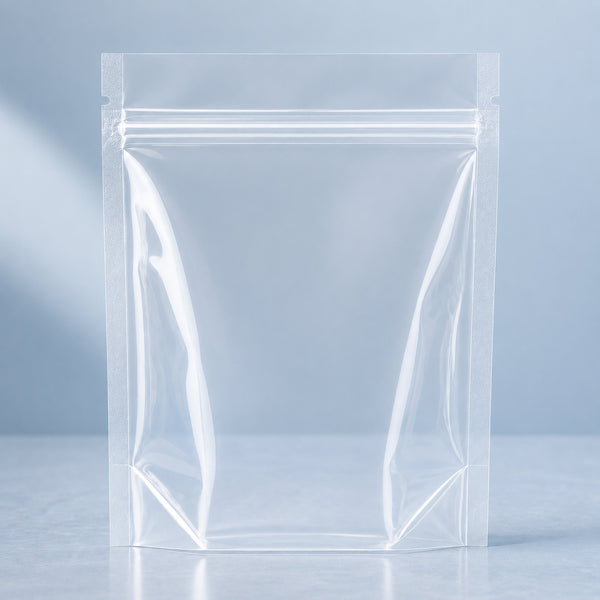 Clear Gloss PETClear view of the product with reflective shine.
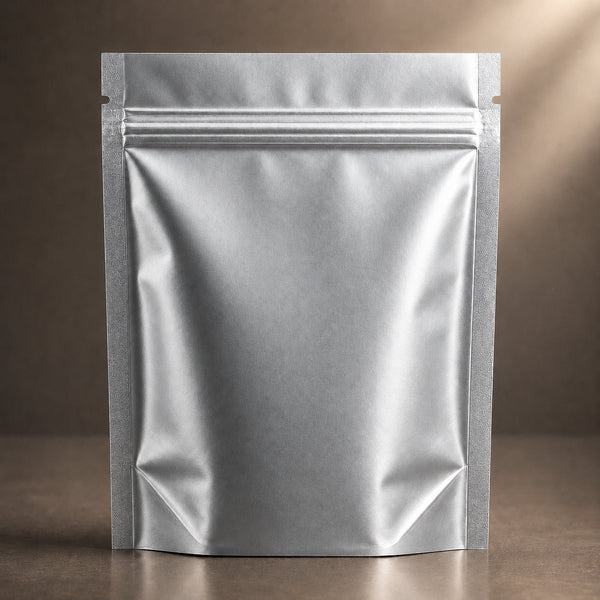 Metallic Matte BOPPMuted metallic look with reduced glare.
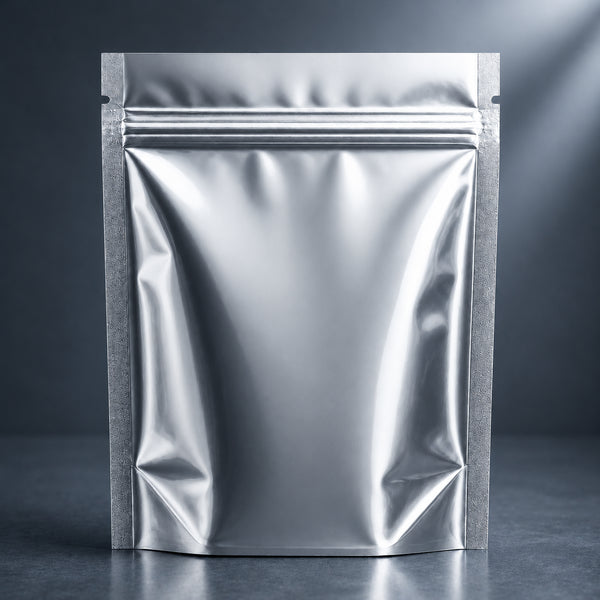 Metallic Gloss PETBright metallic look with reflective finish.
Compare all six pouch materials
Values from CPP's specification sheets (Edition 1.0, September 2026). Layers are listed from the outside of the pouch to the inside.
| Material | Look | Layers (outside → inside) | OTR (cm³/100 in²/24 hr) | WVTR (g/100 in²/24 hr) | Seal strength (lb/in) |
|---|---|---|---|---|---|
| White Matte BOPP | Opaque white base, smooth low-sheen finish | 1.3 mil matte BOPP / 48 ga PET / 3.0 mil white EVOH PE | ≤0.06 | ≤0.063 | ≥9 |
| White Gloss PET | Opaque white base, bright reflective finish | 1.2 mil gloss PET / 48 ga PET / 3.0 mil white EVOH PE | ≤0.06 | ≤0.063 | ≥9 |
| Clear Matte BOPP | Soft, frosted view of the product | 1.3 mil matte BOPP / 48 ga PET / 3.0 mil clear EVOH PE | ≤0.06 | ≤0.063 | ≥9 |
| Clear Gloss PET | Clear view of the product with reflective shine | 1.2 mil gloss PET / 48 ga PET / 3.0 mil clear EVOH PE | ≤0.06 | ≤0.063 | ≥9 |
| Metallic Matte BOPP | Muted metallic look with reduced glare | 1.3 mil matte BOPP / 48 ga metallized PET / 3.0 mil clear mLLDPE | ≤0.03 | ≤0.13 | ≥7 |
| Metallic Gloss PET | Bright metallic look with reflective finish | 1.2 mil gloss PET / 48 ga metallized PET / 3.0 mil clear mLLDPE | ≤0.03 | ≤0.13 | ≥7 |
OTR is oxygen transmission rate; WVTR is water-vapor transmission rate. The sheets report OTR per ASTM D3985, WVTR per ASTM F1249 and self-to-self seal strength per ASTM F88. These are listed specification limits, not finished-package guarantees. Temperature and humidity are not provided for the barrier tests; confirm matching test conditions before comparing films or suppliers.
Shared by all six:
| Specification | Value |
|---|---|
| Total thickness | 4.8 mil (about 122 µm) for gloss, 4.9 mil (about 124.5 µm) for matte; ±10% |
| Film sealing reference | 250–350 °F (120–180 °C), as listed in the sheets; not a validated setting for a finished pouch or your sealer. Confirm placement, temperature, pressure and dwell time with a pouch trial. |
| Empty material storage | 50–80 °F (10–26 °C), 30–70% relative humidity, 12 months from delivery |
| Formats | Stand-up and flat pouches; confirm availability for your size and features |
Download the 2-page comparison guide (PDF, 372 KB)
Matte vs. gloss: what changes?
In CPP's paired specifications, the exterior layer and total thickness differ. Matte finishes use a 1.3 mil BOPP exterior with high haze (≥70%) and low gloss (≤8%), which softens reflections and gives a velvety, low-glare surface. Gloss finishes use a 1.2 mil PET exterior with high gloss (≥70%) and low haze (≤10%), which makes colors look brighter and clear areas see-through. Within the same base, matte and gloss list identical oxygen, moisture and seal-strength values.
| Comparison | Matte (BOPP exterior) | Gloss (PET exterior) |
|---|---|---|
| Appearance | Soft, low-sheen, reduced glare | Bright, reflective, vivid color |
| Haze / gloss | Haze ≥70%, gloss ≤8% | Haze ≤10%, gloss ≥70% |
| On clear film | Frosted view of the product | See-through view of the product |
| Exterior friction (COF) | ≤0.4 | ≤0.5 |
White, clear or metallic: which base?
The base determines product visibility and is part of the film's barrier structure. White and clear use the same middle layer and an EVOH PE sealant. Metallic adds a metallized PET middle layer and an mLLDPE sealant.
| Comparison | White | Clear | Metallic |
|---|---|---|---|
| Product visibility | None (opaque) | Full or frosted view | None (opaque, silver-toned) |
| Print effect | Clean, accurate color on white | Ink over transparent film; use white ink where color must stay solid | Reflective metallic effects; protected white areas for solid color |
| OTR (cm³/100 in²/24 hr) | ≤0.06 | ≤0.06 | ≤0.03 |
| WVTR (g/100 in²/24 hr) | ≤0.063 | ≤0.063 | ≤0.13 |
| Seal strength | ≥9 lb/in | ≥9 lb/in | ≥7 lb/in |
For artwork on clear or metallic film, see the Creating Clear Windows and Creating Metallic Effects guides on the artwork page.
How do I choose a pouch material?
Start with the product, then the look. Use this table to shortlist, then test the filled pouch.
| If your priority is… | Start with | Why |
|---|---|---|
| Showing the product | Clear Gloss PET | See-through view with reflective shine |
| Showing the product with a softer look | Clear Matte BOPP | Frosted, low-glare view |
| Keeping oxygen out | Metallic Matte BOPP or Metallic Gloss PET | Lowest listed OTR (≤0.03); confirm comparable test conditions |
| Keeping moisture out | White or clear options | Lowest listed WVTR (≤0.063); confirm comparable test conditions |
| Bright, accurate brand colors | White Gloss PET | Opaque white base with a reflective finish |
| A premium, low-glare shelf look | White Matte BOPP or Metallic Matte BOPP | Matte exterior with haze ≥70% |
Not sure? Ask the CPP team with your product, fill method and storage conditions.
What the specs don't tell you
- Shelf life: film transmission values don't set a product's shelf life. Seals, filling, storage, distribution and repeated opening all matter.
- Light protection: opacity isn't measured as light transmission in the spec sheets, so don't assume a light-protection level.
- Food contact: the spec sheets cite FDA regulations for individual layers, not a finished-pouch approval for your product.
- Odor and gas: neither figure measures odor containment, and CPP pouches don't include degassing valves.
Spec sheet downloads
Each two-page PDF lists the layers, test values, test methods, food-contact references and storage terms. The same specification applies to stand-up and flat pouches.
| Material | Specification | Page |
|---|---|---|
| White Matte BOPP | Spec sheet (PDF, 217 KB) | Details |
| White Gloss PET | Spec sheet (PDF, 217 KB) | Details |
| Clear Matte BOPP | Spec sheet (PDF, 217 KB) | Details |
| Clear Gloss PET | Spec sheet (PDF, 217 KB) | Details |
| Metallic Matte BOPP | Spec sheet (PDF, 217 KB) | Details |
| Metallic Gloss PET | Spec sheet (PDF, 217 KB) | Details |
Pouch materials FAQs
What is the difference between pouch materials and finishes?
The material base is white, clear or metallic, and the finish is the matte or gloss exterior. Each of CPP's six pairings is a defined three-layer laminate with its own specification sheet.
Is BOPP or PET better for a pouch?
At CPP the choice only changes the outer layer: matte finishes use a 1.3 mil BOPP exterior and gloss finishes use a 1.2 mil PET exterior. Within the same base, both list the same oxygen, moisture and seal-strength values, so choose the finish for look and feel.
Which pouch material has the best barrier?
It depends on whether oxygen or moisture is your priority. Metallic lists the lowest OTR limit (≤0.03 cm³/100 in²/24 hr); white and clear list the lowest WVTR limit (≤0.063 g/100 in²/24 hr). The sheets omit temperature and humidity for these tests, so confirm comparable conditions and test the filled pouch before choosing on barrier performance.
Are metallic pouches the same as Mylar bags?
Mylar® is a brand of PET film, not a specification for every metallic pouch. CPP's metallic options use a metallized PET middle layer between a BOPP or PET exterior and an mLLDPE sealant.
Does a lower OTR or WVTR guarantee a longer shelf life?
No. OTR and WVTR describe how much oxygen or water vapor passes through the film under test conditions. Shelf life also depends on the product, seals, filling, storage, distribution and repeated opening, so validate the finished package.
Are CPP pouch materials food safe?
CPP's specification sheets cite FDA food-contact regulations for individual layers, such as 21 CFR 177.1520 for BOPP and mLLDPE, 177.1630 for PET and 177.1360 for EVOH. They don't certify the finished pouch for a specific food, so confirm suitability for your product and process.
Can I show my product through the pouch?
Yes, with a clear material. Clear Gloss PET gives a see-through view; Clear Matte BOPP gives a hazy, frosted view. Mark printed, white-ink and transparent areas in your artwork and check visibility on a physical sample.
How should I store empty pouches?
CPP's specification sheets list storage at 50–80 °F (10–26 °C) and 30–70% relative humidity, with a material storage period of 12 months from delivery. That period is for the empty material, not a shelf life for your product.
Build your pouch around your product
Choose the format, size, material and finish, features, quantity and production speed to see a live custom quote.