

Clear Gloss PET Materials and Finishes
Clear packaging with a polished shine
Show off the product inside
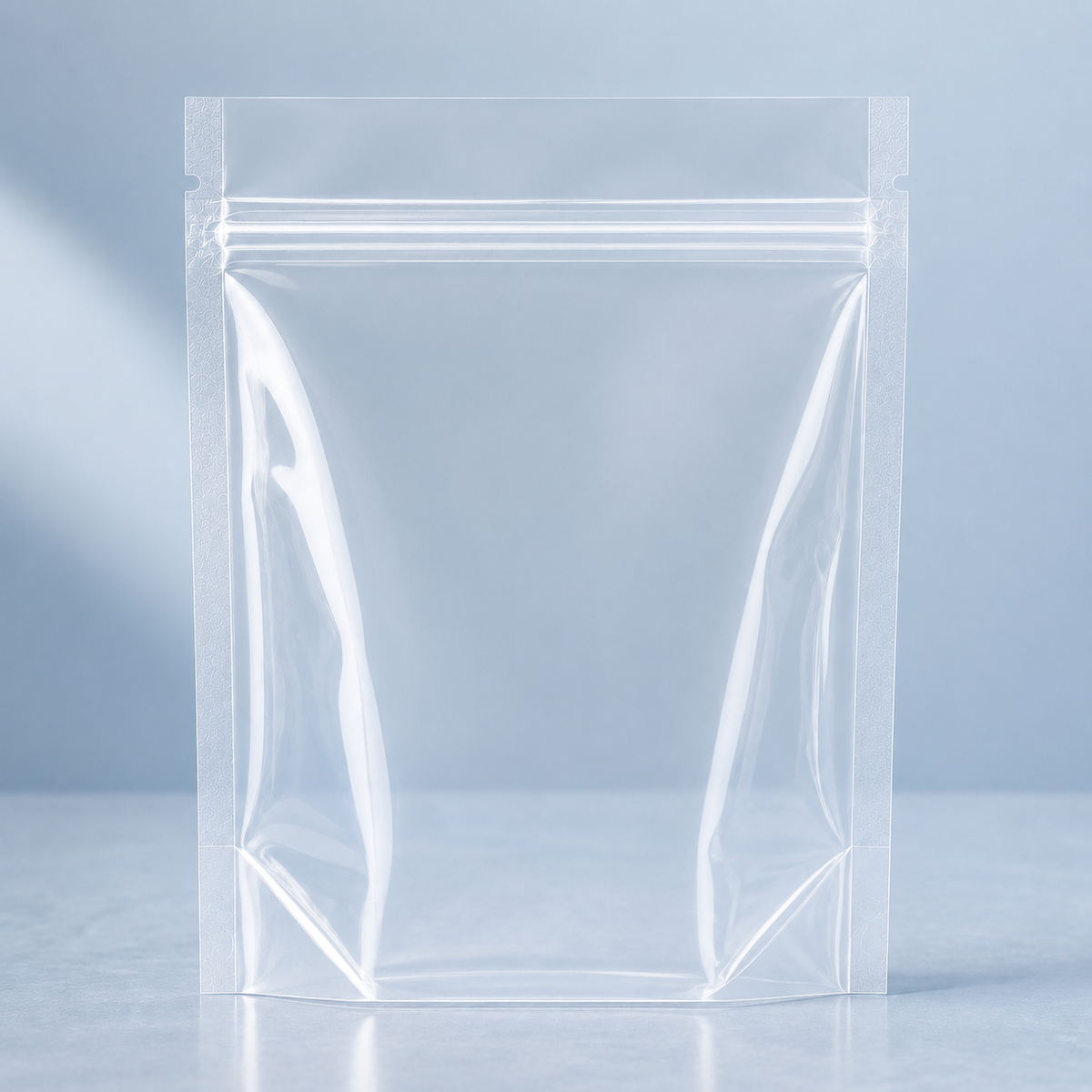
Clear Gloss PET combines transparency with a bright, reflective exterior for clear product windows, glossy graphics and high visual contrast.
Consider it when product visibility and a polished, high-shine surface are both central to the package design.
Performance at a glance
These are the headline values buyers and production teams usually need first. The test method matters whenever values are compared.
Three layers, three distinct jobs
The exterior layer creates the finish, the print layer carries the graphics, and the interior sealant forms the package interior.
Could this work for your product?
Use this checklist to identify practical starting points and the testing a product may need. The film specification does not certify a finished pouch for a product category.
-
Dry snacks and baked goodsStrong starting point
This option lists OTR of ≤0.06 cm³/100 in²/24 hr and WVTR of ≤0.063 g/100 in²/24 hr, with an EVOH PE sealant. Test fragile or sharp products for breakage and puncture.
-
Coffee, tea, herbs and spicesStrong starting point
Evaluate aroma retention, moisture exposure, reclosure and the target shelf life. Coffee may also need a degassing valve. The clear base supports product visibility. Confirm whether light exposure affects the product.
-
Powders and dry supplementsStrong starting point
Confirm particle size, dust at the seal, dispensing method and serving routine with production samples.
-
Oily or greasy dry foodsProduct testing required
Test product-to-film compatibility, grease at the seal, filled-pouch strength and the complete shelf-life plan.
-
Moist or semi-moist foodsProduct testing required
Validate the actual recipe, water activity, seal integrity, storage conditions and food-safety process. Thermal processing is not established here.
-
Liquids and semi-liquidsNot qualified by this specification alone
Use compatibility, leak, drop and distribution testing. Confirm the seal, closure or spout, fill temperature and pouch format for the actual product.
-
Cosmetics and personal-care productsCompatibility testing required
Test the complete formula against the finished pouch for migration, panel distortion, seal performance and leakage.
-
Dry non-food goodsStrong starting point
A practical starting point for dry samples, craft items and small parts when puncture, weight and handling are tested.
-
Medical, hazardous or child-resistant usesNot established by this specification
Confirm every regulatory, safety, barrier and package-performance requirement for the intended product and market.
Complete technical specifications
- Thickness tolerance
- ±10%
- Composite yield
- 5,698 in²/lb
- Exterior COF
- ≤0.5
- Interior COF
- 0.20-0.35
- Haze
- ≤10% (ASTM D1003)
- Gloss
- ≥70% (GB/T 8807)
- Seal strength
- ≥9 lb/in (ASTM F88)
- Seal temperature
- 250-350°F (120-180°C)
- OTR
- ≤0.06 cm³/100 in²/24 hr (ASTM D3985)
- WVTR
- ≤0.063 g/100 in²/24 hr (ASTM F1249)
- Thickness methods
- GB/T 6672 for the exterior; ASTM D2103 for print layer and sealant
- Available as
- Pouches only
- Material shelf life
- 12 months from delivery
- Storage
- 50-80°F (10-26°C); 30-70% relative humidity
What to confirm for food-contact use
Referenced regulations: PET: 21 C.F.R. § 177.1630; EVOH: 21 C.F.R. § 177.1360.
These references apply to the identified film components. The finished package and its intended use still need review for the product, processing conditions, jurisdiction and supply-chain requirements.
Take the details with you
Download this option's two-page specification, or compare all six materials and finishes side by side.
Questions about Clear Gloss PET
What makes Clear Gloss PET different?
Clear Gloss PET combines transparency with a bright, reflective exterior for clear product windows, glossy graphics and high visual contrast. Its film layers, thickness and performance values are listed on this page and in the downloadable specification.
Is this the right option for every product?
No. Barrier values describe the film under stated test methods, not guaranteed shelf life for a finished product. Validate the complete product-package system, filling process, seals and distribution conditions before production.
What do OTR and WVTR tell me?
Oxygen transmission rate (OTR) and water vapor transmission rate (WVTR) describe how quickly oxygen or moisture vapor passes through a film under a specified test. Lower numbers indicate less transmission under those conditions, but product needs still require validation.
What sealing temperature should I use?
The specification lists an application range of 250-350°F (120-180°C). Actual settings depend on the equipment, dwell time, pressure, pouch geometry and product, so production trials remain necessary.
Can I download the complete specification?
Yes. Use the PDF button on this page for a two-page guide with the film layers, performance values, standards, storage guidance and food-contact references.
Compare other materials and finishes

Ready to configure your pouch?
Choose your format, size, materials and finishes, features, quantity and production speed.
Explore custom pouchesTechnical values may change; confirm current requirements before production.